The Pennsylvania Supreme Court on Tuesday said the statewide school mask mandate will remain in place as the state’s highest court gets ready to weigh arguments on the issue next week.
On Wednesday, Gov. Tom Wolf’s administration asked the appellate court to keep the masking order in place after the state Commonwealth Court said that it would expire on Dec. 4.
In an order issued Tuesday, the Pennsylvania Supreme Court said that the Commonwealth Court order was lifted pending further consideration following oral argument in the Supreme Court on Dec. 8.
“Nothing in this order shall be construed as a position regarding the merits of this appeal,” the court said.
On Nov. 10, the Commonwealth Court ruled that Acting Health Secretary Alison Beam did not have the authority to issue the mask mandate in August without following the proper state rulemaking procedures. Two groups of parents filed suit against the state alleging that the masking order was not properly issued and that it violated religious freedoms.
Although the administration originally said it would let individual school districts make their own decisions on masking, Beam said in late August the mandate was necessary given the increase in cases at the beginning of the school year.
In issuing its opinion, the Commonwealth Court said that, since there was no emergency declaration in place at the time, Beam was not allowed to issue the order the way that she did.
The Wolf administration, which had already said it would lift the masking order on Jan. 17, immediately appealed, which automatically stayed the Commonwealth Court order.
However, the plaintiffs who initially claimed that the masking order was illegal asked the Commonwealth Court to lift the stay, arguing that it was likely they would win on appeal.
ANKARA, Nov 29 (Reuters) - A Turkish court jailed pending trial Metin Gurcan, a founder of the Turkish opposition Democracy and Progress Party (DEVA), over "political and military espionage," a state-run news agency said on Monday.
Gurcan, a retired member of the Turkish Armed Forces, helped establish DEVA with Ali Babacan, a former deputy prime minister and minister under President Tayyip Erdogan. Gurcan is also a defence analyst.
State-owned Anadolu Agency said police asked Gurcan about his contacts with foreign diplomats based in the Turkish capital Ankara. The court was not immediately available for comment.
Register now for FREE unlimited access to reuters.com
In a televised interview on Monday, Babacan said his party backed Gurcan and its lawyers would support him "until the end." The party was yet to find out about the details of the investigation, Babacan said.
"Gurcan's work is based on open sources. He does not have access to state secrets," Babacan said.
Last week, Babacan said the detention of Gurcan was an attempt at diverting attention from the economic crisis, marked by the currency plunging to all-time lows.
The lira has lost as much as 25% of its value since the beginning of last week over concerns about aggressive interest rate cuts backed by Erdogan.
Polls show support for DEVA, founded in March 2020, around 2%, while support for Erdogan and his AK Party are at multi-year lows. Turks have cited economic mismanagement among the main factors.
DEVA and other opposition parties have called for urgent elections amid the lira meltdown, but the government has said presidential and general elections would be held as planned in June 2023.
Register now for FREE unlimited access to reuters.com
Reporting by Ece Toksabay; editing by Grant McCool
Whatever the future brings for the U.S. economy, know that I won’t lie to you for clicks; it will be based on boring economic models that are back-tested in time and adjusted for new variables 24/7. You can glimpse my mindset in this podcast, which covers the entire COVID-19 crisis and housing. The title I do believe is fitting: Bear Crusher.
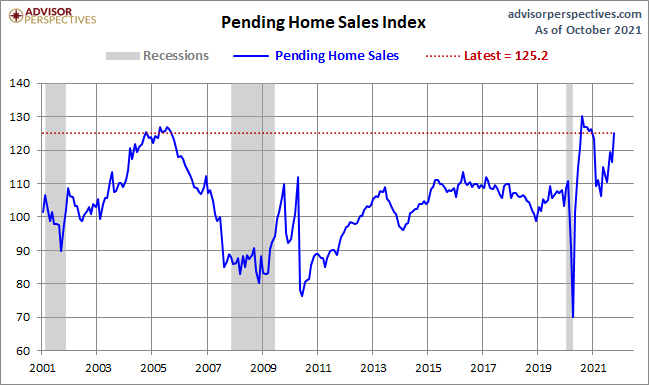
From the National Association of Realtors: “The Pending Home Sales Index (PHSI), a forward-looking indicator of home sales based on contract signings, rose 7.5% to 125.2 in October. Year-over-year, signings fell 1.4%. An index of 100 is equal to the level of contract activity in 2001.”
One of the themes that I wanted to give to my readers is that housing data had surged toward the end of 2020, which created a high that couldn’t be sustained. Home sales had a big gap from trending sales to where total sales closed in 2020. So, what was always going to happen was that housing data would moderate. That moderation will be viewed as housing crashing because I have seen people use this line repeatedly during the last eight years. This is why I recently wrote about what real housing or economic weakness would look like so you don’t get suckered by housing and economic crash addicts.
As we can see below, housing moderated, found a base and moved higher toward the second half of 2021. I stress this as many people had sent me examples of YouTube videos with people touting a second-half housing crash. I can tell you that these people don’t have the training to read housing or economic data correctly. If they did, then the notion of a sales collapse in 2021 — when trend demand data was always showing stability — is ludicrous. Remember, be the detective, not the troll.
Last week, I wrote about how the existing home sales markets outperformed my peak sales range in the past two sales reports. As long as the final two reports of the year are above 6.2 million, you should see that as a beat. Of course, total sales are above my critical level of 6.2 million when adding new home sales. So far, 2020 and 2021 have come in as a noticeable beat in my eyes. Mother Demographics and low mortgage rates are two very hard competitors to go against when advocating an epic housing crash.
From NAR: “Motivated by fast-rising rents and the anticipated increase in mortgage rates, consumers that are on strong financial footing are signing contracts to purchase a home sooner rather than later,” said Lawrence Yun, NAR’s chief economist. “This solid buying is a testament to demand still being relatively high, as it is occurring during a time when inventory is still markedly low.”
Has anyone noticed that over the last eight years everyone blames low inventory when we miss estimates, but they keep quiet about it when sales are beating estimates, while inventory is still falling? Over the years, I have never believed in the premise that low inventory is holding sales back, which was expected whenever sales get weaker. 2020 and 2021 are at pre-cycle highs in demand, with total inventory levels at all-time lows for both years.
Remember, a seller is typically also a buyer, so inventory should fall when demand picks up and that seller finds another home to buy. When inventory rises and more supply is on the market, this means demand is fading. Total inventory levels have been falling since 2014, while sales have been rising. Please don’t forget this in the future, as sales will slow at some point when mortgage demand fades.
From the NAR: “The notable gain in October assures that total existing-home sales in 2021 will exceed 6 million, which will shape up to be the best performance in 15 years.”
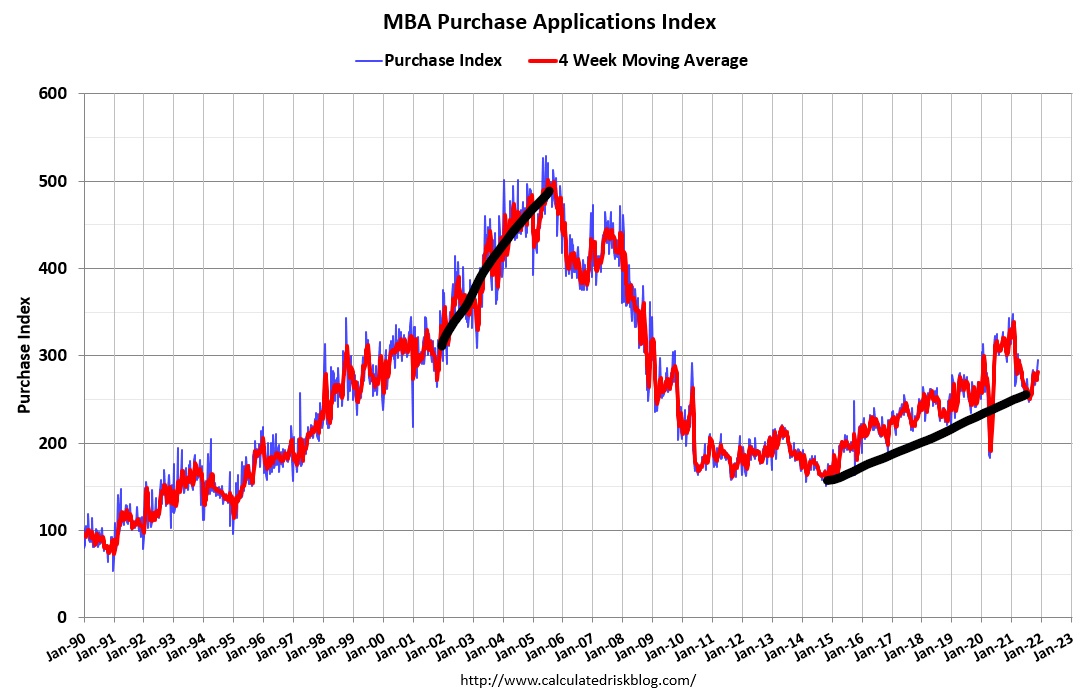
One aspect of housing that doesn’t get enough attention is that mortgage purchase application data has had a nice run for 12 weeks. Earlier in the year, I wrote an article saying that purchase application data was going to be negative year over year in the second half of 2021, and we shouldn’t overreact to this, because the housing crash people will.
It’s the nature of the beast, as I have seen this behavior a lot. The lack of training and not making COVID-19 adjustments to data creates a false sense of reality for housing crash people, and some were pushing the negative year-over-year data as a legit premise for sales to collapse.
Well, as we can see, sales didn’t collapse, but something else happened. The purchase application data was getting better because the year-over-year declines were improving so much that we have a shot to report even a flat or positive print, which will explode my head. Not even I thought that could be possible with such high comps, as we can see below with mortgage demand getting firm.
From July 14 to Sept. 8, purchase application data year over year was trending at roughly negative 18%-19%. The higher comps in 2020 were always going to result in negative year-over-year data this year. However, just taking the last eight weeks, still using high comps, the average decline is roughly 8%-9%. The last three weeks combined is down only 4.6% on average, and this data line looks out 30-90 days.
Yes, seasonality kicked in a while ago, but the firming of this data line is a big deal. Consider this in the context of the focus on iBuyers, which might not even account for 1% of total home sales. The focus has also been on investors because the premise was that without investors, housing would crash. This idea misses out on the real data trends that matter because the biggest homebuyers in America are always mortgage buyers, not investors. We don’t have a Wall Street moat around housing: when mortgage demand fades, so will housing.
Hopefully my work this year can make you understand that sexy ideological headlines might get the press time, but good old boring economic work gets the job done with satisfaction. Today’s pending home sales is just another affirmation of what we’ve seen over the last two years: it’s the Revenge of the Nerds.
Tech biggest S&P sector gainer; financials down most
STOXX up ~0.7%
Dollar, crude gain; gold, bitcoin slip
U.S. 10-year Treasury yield ~1.52%
Nov 29 - Welcome to the home for real-time coverage of markets brought to you by Reuters reporters. You can share your thoughts with us at markets.research@thomsonreuters.com
HOMES FOR THE HOLIDAYS: PENDING HOME SALES JUMP TO 10-MONTH HIGH (1105 ET/1605 GMT)
Housing market data released on Monday supported the notion that the sector, despite slowing down under the weight of its own success, still has some gas in the tank.
Register now for FREE unlimited access to reuters.com
Pending sales of pre-owned U.S. homes (USNCH=ECI) surged by 7.5% last month, blasting past consensus and posting a decisive rebound from September's 2.4% decline, according to the National Association of Realtors (NAR). read more
The increase sent the index to its highest print in ten months, where it hovers well above pre-COVID levels.
"This solid buying is a testament to demand still being relatively high, as it is occurring during a time when inventory is still markedly low," writes Lawrence Yun, NAR's chief economist.
Indeed, while the initial threats - and resulting lockdowns - surrounding the pandemic have waned, its effects don't appear to be going away any time soon, as evidenced the new Omicron variant. read more
As a result, demand for elbow room and home office space remains robust, with many potential buyers finding additional impetus in the form of rising rents and interest rates.
"Motivated by fast-rising rents and the anticipated increase in mortgage rates, consumers that are on strong financial footing are signing contracts to purchase a home sooner rather than later," Yun added.
The initial suburban flight drove inventories to record lows, even as homebuilders struggled replenish those inventories as they wrestled with land scarcity and a hobbled supply chain.
These factors launched home prices into the stratosphere, and beyond the grasp of many potential buyers, particularly and the lower end of the market.
But as Rubeela Farooqi, chief U.S. economist at High Frequency Economics points out, inventories and home prices have both shown recent signs of easing.
"Inventories, while they have declined over the last three months, have moved up from lows earlier this year," Farooqi says. "Gradually easing supply constraints should be a positive for existing home sales over time."
Pending home sales
As a potential home sale is counted as 'pending' once the contract is signed, the data acts as a fairly accurate predictor of actual home sales a month or two down the line.
So, much like the Commerce Department's building permits report, which also showed a nice rebound in October, pending home sales is among the sector's most forward-looking indicators.
But the stock market is the most forward-looking indicator of them all, reflecting where investors believe the housing sector will be six months to a year down the road.
For nearly the first year of the pandemic, the Philadelphia SE Housing index (.HGX) and the S&P 1500 Home Building index (.SPCOMHOME) handily outshone the broader S&P 500.
But as shown in the graphic below, index performance rebased to a year ago shows that relationship has since converged, although the SPCOMHOME has gained an edge of late, nicely echoing the recent uptick in the NAHB's Homebuilder Sentiment index.
Housing stocks
Wall Street was heading sharply higher before the data hit, rebounding from Friday's steep sell-off due to renewed pandemic fears in the form of our newest addition to the common vocabulary 'Omicron.'
But the perennial stay-at-home plays, namely market leading tech megacaps, have since taken a decisive lead, pushing the Nasdaq to the head of the pack.
(Stephen Culp)
*****
RECOVERING FROM OMICRON? GIVE MARKETS 10 DAYS! (0959 ET/1559 GMT)
Even though markets have quickly switched from panic selling to dip-buying, main equity benchmarks remain well below the levels they were at before Omicron jitters wiped $2 trillion off stock markets worldwide.
At this point one may wonder how long could it possibly take for a complete recovery?
To answer that, Mediobanca looked at market behaviour in October last year when the Delta variant was first spotted.
Back then, it took 10 days to rebound and reach new highs, it says, which suggests that this time around the recovery process should be faster, given that the number of vaccinated is much higher and the time to market of new shots is shorter.
"We might be back to highs quite soon," the Italian investment bank wrote in an email to clients.
(Danilo Masoni)
*****
U.S. FUTURES BOUNCING AFTER OMICRON SELL-OFF (0815 ET/1315 GMT)
U.S. equity index futures were pointing towards a higher open on Monday, after Friday's sharp sell-off in a shortened post-Thanksgiving holiday session fueled by the finding of a new coronavirus mutation in South Africa.
A top South African infectious disease expert said on Monday that existing COVID-19 vaccines should be highly effective at preventing severe disease and hospitalization from the new variant, named Omicron, and U.S. President Joe Biden was due to update the public on the new variant and the U.S. response later in the day. read more
The Dow Industrials (.DJI) suffered its biggest one-day percentage decline since October 2020 and the S&P 500 (.SPX) saw its biggest daily percentage drop since February 25 on Friday, as concerns about the new variant rattled markets, although many analysts said the selling was likely exacerbated by the light volume trading session.
After slumping about $10 a barrel on Friday, oil prices were rebounding by about 5% while travel-related stocks such as American Airlines (AAL.O) and Norwegian Cruise Line (NCLH.N) also gained ground after tumbling on Friday.
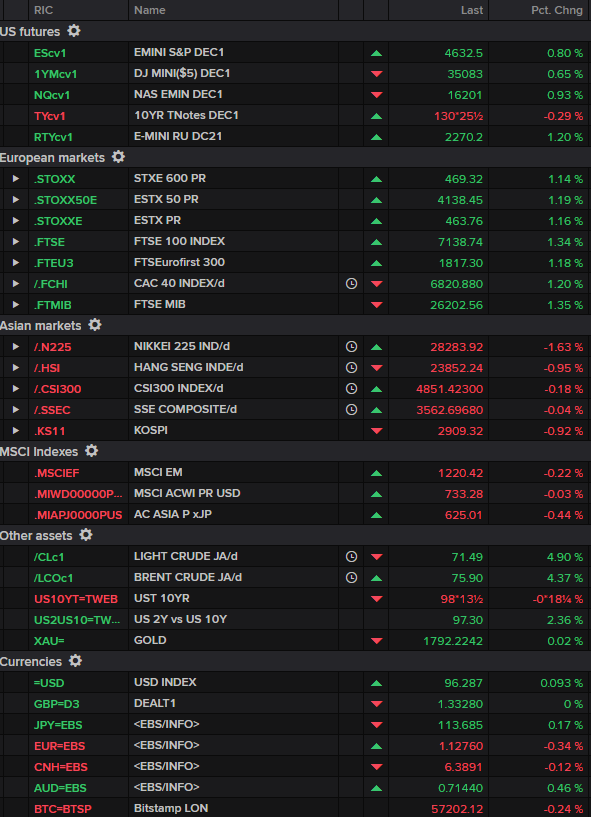
Below is your premarket snapshot:
Futures higher after Friday sell-off
(Chuck Mikolajczak)
*****
FOR MONDAY'S LIVE MARKETS' POSTS PRIOR TO 0830 EST/1330 GMT - CLICK HERE: read more
Register now for FREE unlimited access to reuters.com